Project X Making Of
Server module World Manager with built-in rendering engine
June 2005: First instance of the PC client
Note that I used my favorite set of video game heroes: Mario All-Stars! All these placeholders would be replaced as soon as possible by final artwork.

Network statistics
Implementing networking support requires you to tune bandwidth usage and minimize latency issues. Real-time statistics help a lot in this area.

Dead reckoning and network latency
I developed a dead-reckoning system in order to smooth path prediction for other players’ avatars.
Here you can see some path trails.

July 2005: Building 3D model support
During 3D model support development, I used visual overlays to improve debugging and fine-tuning.

Scaling networking toward a massively connected system
As you can see, I developed a set of embedded tools that continuously profile both network performance and topology.
The circle — with the HUB at the center — shows the distance of each client in terms of round-trip time (in milliseconds).

Client module for the Desktop
Richer world: Adding shaders and programming a real physics engine
A couple of shaders were added to handle special rendering effects. A new kart replaced our former placeholder.
For the ground, I added a texture-splatting system to provide detail without consuming too much memory.

Richer world: Programming a real physics engine
The world was updated with “real” 3D altitude for the ground. Water was integrated with a nice light-reflection system.
My favorite yellow duck was integrated as well, along with a physics engine (floating, falling, and bobbing for the duck).
Cars now benefit from real physics capable of handling collisions (car/ground & car/objects), cars jumping over hills, skidding, and loss of control.
In order to make it even more fun, jumps are really expressive and the car shakes its “nose” when you try to climb steep slopes.

Adding actual 3D assets
The addition of the final artwork — which I wanted to look rough and stylized rather than realistic — gave the finishing touch to this demonstrator of the Project X technology and service.

Client module for mobile handsets equipped with NVIDIA GoForce 4500/4800
April 2005: Reusing a previously developed J2ME 3D engine
As a first full-3D attempt to support MMO connectivity, I recycled a Mario Kart™-like engine that I had previously written for the J2ME platform.
I added the connectivity set of classes and could soon see numerous avatars wandering around the world…

December 2005: Developing the MIDP2 version
The 2D version derives its connectivity code from the desktop version. The rest of the game was written from scratch using MIDP2.
This version features a top-view camera, closer to the final release.
For the purpose of rapidly demoing this version, I used Midtown Madness car sprites as placeholders.

August 2005: First hands-on with the NVIDIA GoForce DevKit
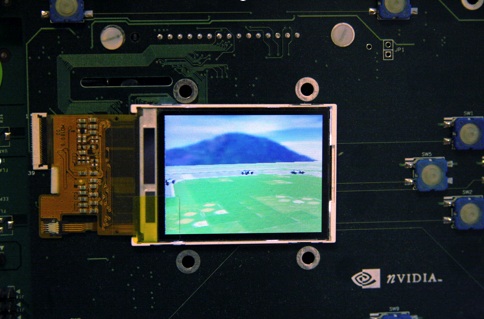
I received a devkit from NVIDIA consisting of a Motorola Linux-based mobile phone prototype. It embeds a GoForce 4500 chip capable of 1.5M triangles/s.
I developed an OpenGL 3D rendering engine in C from scratch to benchmark actual usable performance. It rocks!
I put 32 cars on screen, 4K triangles each, plus the background (a 3D plane of 4,096 quads). It sustains 30 fps.
Of course, the final game had to be written in Java J2ME and support JSR-184.